
The Progress screen
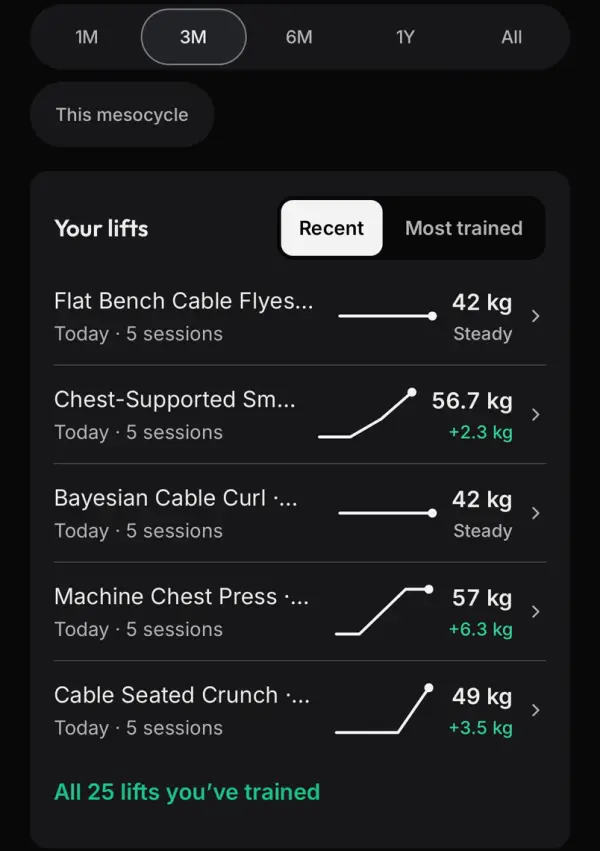
Progress answers one question: is your training working? Over one range it lists your lifts with their estimated max and its trend, your newest records, and a row each for your weeks, your muscles and your body. Tap any of them for its detail.
How it works
- Range: at the top, from one month to all time, or this mesocycle while a program runs. Everything on the screen reads it.
- Your lifts: 5 lifts trained in the range, the most recent first or the most trained, each with its estimated one-rep max (e1RM) from the best set of each workout, its change and a small line. A lift needs 2 workouts in the range to show a change. A change within 2% either way reads Steady: that is normal day-to-day noise. “All lifts you’ve trained” lists the rest, with search.
- Plateau: a lift with no new best for 6 weeks and at least 4 workouts reads Flat, with its weeks, even if the range as a whole went up. Deloads and easy days do not count against it.
- New records: the range’s newest PRs, one card each, and a link to Records for every lift’s bests.
- Your weeks: your training days a week, using the weekly board’s rule (3 working sets or a short cardio session in a day), and the time or volume load (weight × reps of your working sets) of each week. On This mesocycle it also counts planned workouts done. Weeks start on your “Week starts on” day. Volume load is a rough measure of work; sets per muscle is the better guide to growth.
- Muscles: how many of the 8 muscle groups were in range last week (enough working sets, and not past their maximum), counted like Muscles this week (a set on a muscle that only helps counts as part of a set). A muscle is named only after 2 full weeks in a row under its target or past its maximum, so one short week is ignored.
- Body: a rolling week’s average of your weigh-ins, and its rate a week, once there are 14 days of them. Its line flags losing or gaining faster than is usually wise.
Example
Your bench rose 4% over 12 weeks, but its row reads “Flat 6 wk”: the gain came early and the last 6 weeks set no new best. That, not the +4%, is the one to act on.
What to do
Look for a lift that reads Flat (see Progression for what to change) or a muscle short of sets. Without Pro, Progress looks back 3 months, a stalled lift shows its kilos instead of Flat, and the lines on muscles and body are Pro’s.
Sources
- e1RM: Epley 1985 (Poundage Chart, Body Enterprises): weight × (1 + reps ÷ 30), on reps + RIR, capped at 12 reps since estimates drift past ~10 reps.
Read next
- e1RM
Your estimated one-rep max on each lift
- Progression
When the weight goes up, holds or comes down
- Mesocycles and deloads
3 to 6 weeks that get harder, then a lighter week