
e1RM
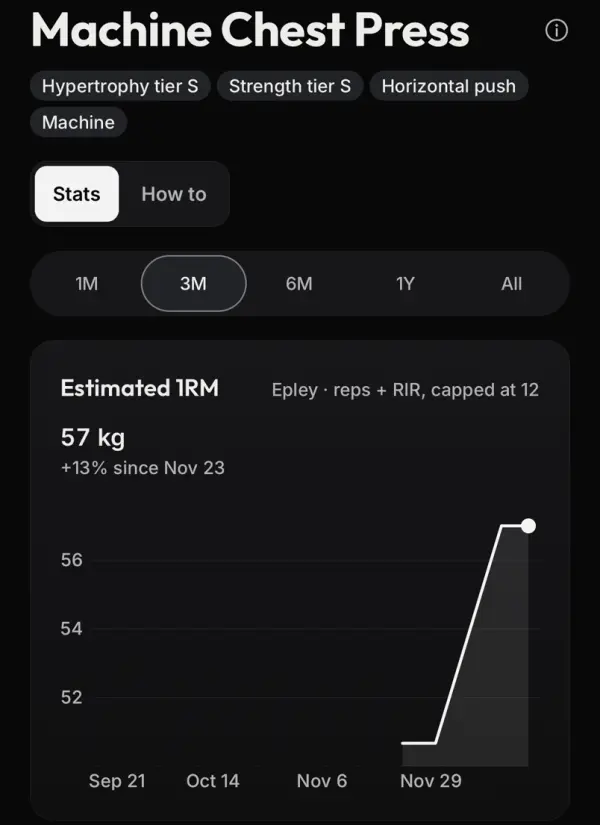
Estimated one-rep max. The most you could lift once, worked out from a set of several reps and how many you had left. It tracks strength without testing a max.
How it works
- It is worked out from your weight, reps and reps in reserve with the Epley formula (below).
- Reps plus reps left count up to 12: past that the estimate drifts, so it stays on the safe side.
- Each lift has its own, and so does each machine: a leg press on one sled and on another are different lifts.
- It moves when you do more reps at a weight, or the same reps at a heavier one. A bad day can lower it; the next good one brings it back.
- You see it on each exercise’s page, in Progress and in your records. A % of e1RM program reads it to set your weight, and Work reads it to know how heavy a set is for you.
Example
100 kg × 5 with 1 rep left is an e1RM of about 120 kg. Next week 6 reps at the same weight raises it to about 123 kg.
What to do
Watch the trend, not one session. Rating your reps in reserve honestly keeps it accurate.
Sources
- e1RM: Epley 1985 (Poundage Chart, Body Enterprises): weight × (1 + reps ÷ 30), on reps + RIR, capped at 12 reps since estimates drift past ~10 reps.
Read next
- RIR and RPE
How hard a set was, two ways to say it
- XP and Work
How a set turns into Work, and Work into XP