Posture plan
The posture plan is an alignment and mobility plan built from your posture check: short follow-along sessions matched to the readings outside the typical range, with a photo check-in that shows what changed. It is free, it runs next to your lifting or cardio plan, and it is not medical care.
How it works
- Starting one: from a posture check’s result, from Body › Posture, from Ready-made plans (under Mobility), or from Make one for me when you have a recent check. It starts from a check taken in the last 2 weeks; with none, it asks for one first.
- Setup: 3 to 5 sessions a week, 10 to 20 minutes each, for 6 or 8 weeks. It starts on 3 sessions of 20 minutes for 8 weeks, the closest to what the studies used.
- A session mixes moves from the guided routines with strength work, no equipment needed. A forward head or shoulders get chest and neck stretches with chin tucks and Supermans; the hips get hip stretches with glute bridges and dead bugs; uneven shoulders or hips get side planks and side-lying leg raises; the knees get balance work with clamshells and glute bridges. Each session starts one move further into its lists, so the week varies.
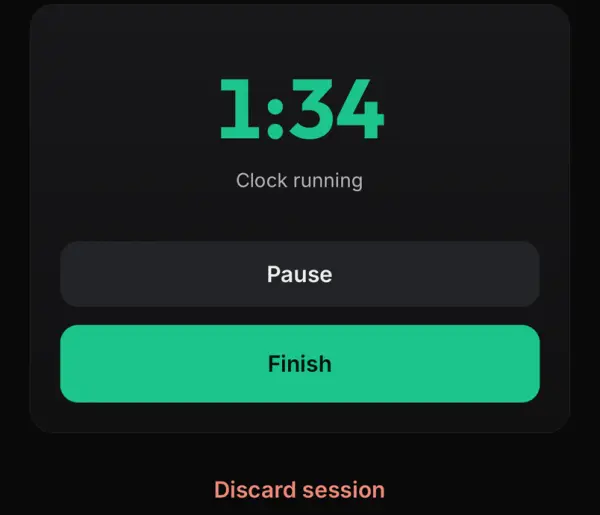
- It runs like any routine: a countdown for each move, with Skip and more time, a voice that names each move and counts you through it (Settings › Sound & voice), and it saves as a timed Mobility session. Home shows today’s session under your training, one a day until the week’s sessions are done.
- Train’s Plan tab shows the plan under your lifting or cardio plan: its week and this week’s days, each saying what else that day holds (“with Push A”, or “rest day”). Its sessions go on your rest days first. Tap a session to see its moves. A posture session never uses up your other plan’s day: do it and Push A the same day and both count, or do only the posture session and Push A is still today’s.
- Check-ins: at week 4 and when the plan ends, the plan day is a Posture check-in: two photos, like your first check. A check-in is always free on its day, whether or not your next free posture check has opened. Turn on Remind me to re-check to get a reminder that day. We chose week 4 because that is the earliest studies measured a change; sooner, a photo mostly shows day-to-day differences. A check-in you have not taken stays due until the next one comes up, then it shows as Skipped; nothing is lost, the next one still compares with your first check.
- The comparison: each reading against the check you started from. Closer to the line, Further from the line, or About the same. Two photos of the same stance can differ by about 5° from the side and 2° for the shoulder and hip level, so a change smaller than that always reads About the same.
- After a check-in: a reading that moved closer gets fewer moves in the weeks after, and one that did not keeps its share. A reading that moved outside the typical range by more than the photo’s error is added.
- What to expect: the studies behind the plan measured the head and shoulders, where exercise did move the angle over weeks. For the hips, knees and level lines nobody has shown a standing photo changes with exercise; the plan still trains the muscles around them, and the check-in says honestly when nothing moved.
- When it ends: the closing check shows the change over the whole plan, and Start the next weeks begins another from that check. End plan, in the ⋯, stops it any time; your sessions and checks stay in your history.
Example
Your check reads your head 24° forward. You do 3 sessions a week. At week 4 it reads 21°: About the same, since 3° is inside the photo’s error. At week 8 it reads 18°: Closer to the line, the second of the plan’s 2 check-ins.
What to do
Take every check in the same spot, light and time of day, standing the way you normally do. Do the sessions on days that suit you; next to a lifting day is fine. Read About the same as normal, not as failing.
Sources
- Exercise and head position: Across 7 trials, exercise programmes moved the head’s angle toward the shoulders. Sheikhhoseini et al. 2018, J Manipulative Physiol Ther 41(6):530–539 (meta-analysis)
- How long and how often: Trials for head, neck and trunk alignment ran 2 to 13 weeks, most often 8, usually 3 sessions a week. Bayattork et al. 2020, J Exerc Rehabil 16(1):36–48 (systematic review)
- The moves: Chin tucks, prone shoulder-blade work and chest and neck stretches, 3 times a week for 8 weeks, moved the head and shoulder angles in adolescents. Heydari et al. 2022, BMC Pediatr 22:230
- Photo error: A phone app’s head angle, retested a week apart, needed about 5° of change to be more than error. Gallego-Izquierdo et al. 2020, Int J Environ Res Public Health 17(18):6521
- Knees and hips: Hip and ankle programmes changed how the knee tracks in movement; studies did not measure standing alignment. Sahabuddin et al. 2021, PeerJ 9:e11731 (systematic review)
- Posture and pain: Reviews do not agree that how someone stands causes back pain, so the plan promises nothing about pain. Swain et al. 2020, J Biomech 102:109312 (systematic review of reviews)
Read next
- Posture check
Two standing photos, read on your phone, and the routines that fit
- Mobility and balance routines
Follow-along stretching, mobility and balance, timed for you
- Programs
Built for you, from the library, or your own