Machines and sensors
Pair a Bluetooth fitness machine, a bike speed or cadence sensor, a pedal or crank watts meter or a heart-rate strap once, and its numbers show live during a timed session or a cardio block, then save with it.
How it works
- What works: smart bikes, treadmills, rowers, ellipticals and stair climbers that speak the Bluetooth fitness machine standard (FTMS), Bluetooth speed and cadence sensors, pedal or crank meters that measure watts, and Bluetooth heart-rate straps. A sensor that does both Bluetooth and ANT+ works over Bluetooth; ANT+ alone does not, phones have no ANT+ radio.
- What doesn't: many gym machines and most air bikes have no Bluetooth or use their own app's private connection. If a machine never shows up when you connect, it doesn't support FTMS.
- Pairing: Settings › Workout › Machines and sensors › Connect a machine. The phone asks for Bluetooth the first time you tap it. Wake the machine (pedal, or press Start) or put the strap on, then tap it in the list. Each one is remembered on this phone.
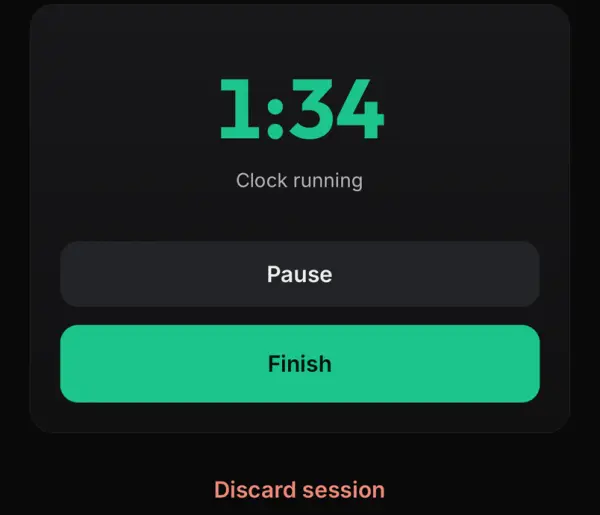
- At the start of a timed session or a cardio block, every paired device in range connects on its own. If one drops out, the strip says "Reconnecting…" and keeps trying; your session and its clock carry on and nothing is lost.
- What shows: a bike shows watts, cadence and speed; a treadmill speed, incline and pace; a rower strokes a minute, split per 500 m and watts; an elliptical or stair climber steps a minute and level. Bike sensors show cadence, plus speed and distance from a wheel sensor and watts from a pedal or crank meter. When a machine and a sensor send the same number, the machine wins.
- Speed or cadence: a sensor on the crank measures cadence only; one on the wheel hub measures speed and distance, and needs the wheel size (⋯ › Wheel size): pick a common tyre size or type its circumference, 900 to 2500 mm. A crank still for 3 seconds drops the cadence to zero.
- Heart rate: a chest strap wins over your watch, and your watch over the machine’s own reading (usually its hand grips). A strap reads your heart’s electrical signal, so it stays accurate when your arms move and your heart rate changes fast; a wrist sensor can lag or drift. If the strap drops out or sends nothing for 5 seconds, the watch takes over, then the machine, and the strap takes back over as soon as it is back. The zone cues carry on through the switch.
- What saves: the machine’s distance, average and top watts and speed, and average cadence, shown on the summary and in History. A cadence sensor alone saves cadence only. A bike’s or wheel sensor’s distance fills in the distance for a ride, and a treadmill’s for a run or a walk; a rower’s or an elliptical’s metres are not real distance and never count toward a record. Records still check the distance is possible for the time.
- The plan sets the machine (⋯ › Plan targets): pick watts or a level (speed and incline on a treadmill) for work and for easy. Intervals switch between them at each phase, a steady block holds the work target, and nothing is sent while you are paused. If the machine refuses or doesn't answer within 4 seconds, the app lets go of it, shows why, and you set it yourself from then on.
- Let me ride: one tap on the strip hands the machine back to you for the rest of the session.
- Your watch shows the machine’s main numbers on its interval screen, sent from the phone.
Example
You pair a smart bike and set its Plan targets to watts. On a Norwegian 4×4 the bike holds your work watts for each 4-minute round and drops to your easy watts for the 3-minute rests. The summary then shows the ride’s distance and your average watts.
What to do
Open Settings › Workout › Machines and sensors and connect your bike, treadmill, sensor or strap before your next cardio session.
Sources
- The machine standard: Bluetooth SIG, Fitness Machine Service 1.0 (2017)
- Bike sensors and straps: Bluetooth SIG, Cycling Speed and Cadence Service 1.0, Cycling Power Service 1.1, Heart Rate Service 1.0
- Chest strap over the wrist: Gillinov et al. 2017, Variable Accuracy of Wearable Heart Rate Monitors during Aerobic Exercise, Med Sci Sports Exerc 49(8):1697–1703
Read next
- Timed sessions
Runs, rides, swims, classes, intervals and yoga on the clock
- Apple Watch
Heart rate, logging sets from your wrist, whole workouts without your phone, and complications on your watch face
- Your gyms
Set up a gym, keep several, and swap gyms for a workout