
Set schemes
A set scheme decides how an exercise’s sets relate to each other on the day. Most exercises use straight sets; strength lifts often use a top set.
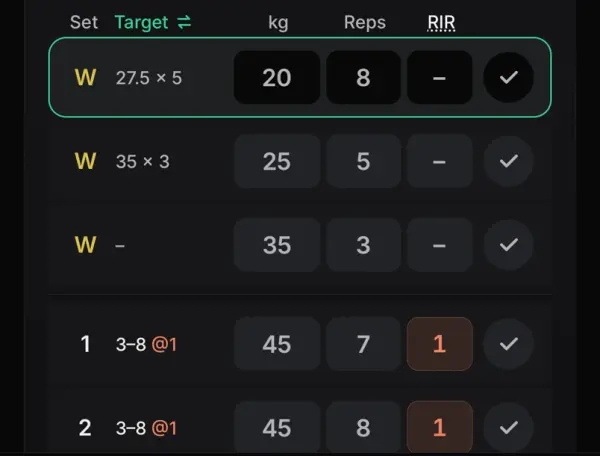
How it works
- Straight sets: Every set the same weight and reps, with full rest between.
- Top set + back-offs: One heavy set at a target effort, then lighter sets worked out from what you lifted. Back-offs come off the weight you actually lifted, 5–20% lighter.
- Ascending: Climb in jumps to one top set at a target effort, each jump from how the last set felt.
- The top set sets the next workout: on target or easier and it goes up (at most 5% at a time), one rep harder and it holds, 2 or more reps harder and it comes down.
Example
Top set: a single at 100 kg with 2 reps left. Back-offs: 3 × 5 at 10% off, 90 kg. Ascending to the same single might climb 88, 93, 97, 100% of it.
What to do
Use a top set for your main strength lift if you like to judge the day by how one heavy set feels; straight sets for everything else.
Sources
- A top set rated by effort, then back-offs set from it, is how autoregulated strength training is written; effort-based loading matched or beat fixed percentages. Helms et al. 2016, Strength Cond J; Helms et al. 2018, Front Physiol; Graham & Cleather 2021, J Strength Cond Res
Read next
- RIR and RPE
How hard a set was, two ways to say it