RIR and RPE
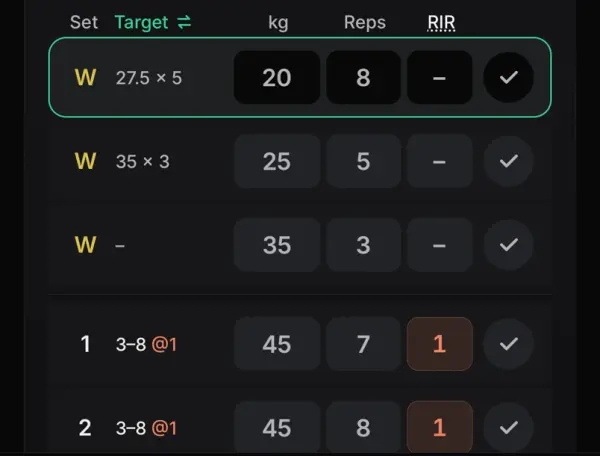
RIR (reps in reserve): How many more reps you could still do when you stop the set. Lower means closer to failure. The target stays the same on every set, so your reps usually drop a little from set to set. RPE (rating of perceived exertion) says the same thing out of 10: RPE 10 is nothing left, RPE 8 is 2 left.
How it works
- RPE is 10 minus RIR. Choose which one you see in Settings › Effort scale; the app stores and scores the same either way.
- RIR goes from 0 (nothing left) to 5+ (an easy set).
- A target reads like “8–15 @2”: the reps, then the reps to leave in the tank. Your first workout says it in words once, under the set you are on, until you tick it.
- To judge it, ask at the end of the set: if I had to, how many more clean reps could I do? Most people guess too high at first, and get better closer to failure.
- Your reps in reserve drive almost everything: your next weight, your estimated max and the Work a set earns.
Example
You do 10 reps and could have done 12: that is RIR 2, or RPE 8.
What to do
Be honest rather than brave. If you are unsure, take a set to failure now and then to learn what 1 or 2 reps left feels like.
Sources
- RIR: Zourdos et al. 2016, J Strength Cond Res 30(1):267–275 (the RIR-based effort scale); Helms et al. 2016, Strength Cond J 38(4):42–49 (effort prescribed per set: at one load, reps fall across sets at the same RIR).
- RPE: Zourdos et al. 2016, J Strength Cond Res 30(1):267–275: RPE 10 = 0 RIR, RPE 9 = 1 RIR, and so on.
Read next
- e1RM
Your estimated one-rep max on each lift
- Progression
When the weight goes up, holds or comes down