
Rep schemes
A rep scheme decides how an exercise’s reps and weight change from week to week. Most exercises use the default, a rep range with reps in reserve.
How it works
- Rep range + RIR: Add reps inside the range, then load, at the reps in reserve you set.
- Static: The simplest: fixed sets × reps, more load when every set hits. Not the best for strength.
- Linear: Reps go down and load goes up week by week across the mesocycle.
- Reverse linear: Reps go up and load goes down across the weeks: an endurance pick, not a strength one.
- Undulating: Heavy, medium and light sessions in turn: growth like linear, and variety for strength.
- Undulating days: heavy is 3–5 reps, medium 6–8 and light 10–12, each stopping 2 reps short of failure. The lifts of one day take turns, so a day is not all heavy.
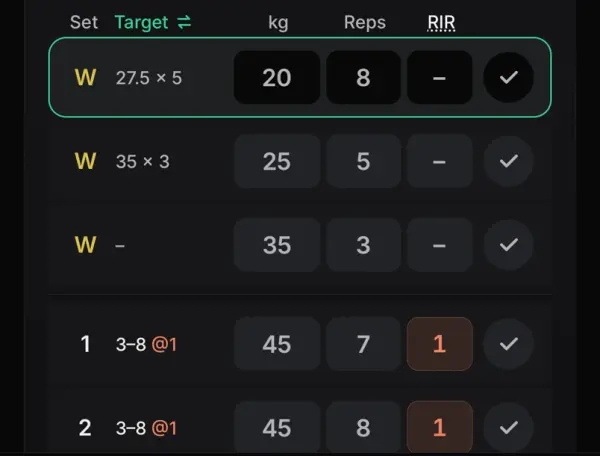
- Change it: open a day of your program, tap the exercise, then Rep scheme. The logger names the week and the reps it aims for.
Example
A rep range of 6–10 on Linear over 4 weeks aims for 10, 9, 7, 6 reps, week by week, and the weight climbs as the reps come down. On Static it stays at 10 reps and the weight goes up once every set gets there.
What to do
Keep Rep range + RIR unless you have a reason: it adjusts to how you are doing. Pick Linear or Undulating for a strength focus, Static for simplicity.
Sources
- Rep range + RIR: Graham & Cleather 2021, J Strength Cond Res
- Static: Ratamess et al. 2009 (ACSM); Williams et al. 2017, Sports Med
- Linear: Williams et al. 2017, Sports Med
- Reverse linear: Rhea et al. 2003, J Strength Cond Res
- Undulating: Grgic et al. 2017, PeerJ; Williams et al. 2017, Sports Med
Read next
- Set schemes
Straight sets, a top set with back-offs, or climbing
- Progression
When the weight goes up, holds or comes down